University of California, Riverside nanotechnologists have succeeded in controlling the color of very small particles of iron oxide suspended in water simply by applying an external magnetic field to the solution. The discovery has potential to greatly improve the quality and size of electronic display screens and to enable the manufacture of products such as erasable and rewritable electronic paper and ink that can change color electromagnetically.
When the strength of the magnetic field is changed, it alters the arrangement of the spherical iron oxide particles in solution, thereby modifying how light falling on the particles passes through or is deflected by the solution.In their experiments, the researchers found that by changing the strength of the magnetic field they were able to change the color of the iron oxide solution â similar to adjusting the color of a television screen image. They have used the superparamagnetic property of iron oxide particles to tune the spacing between nanoparticles, and therefore the wavelength of the light reflection â or the color of the colloidal crystals â by changing the strength of the external magnetic field.
No one's even sure what to call it. "Claytronics," "synthetic reality" and "programmable matter" have been proposed. "Dynamic physical rendering" is the label Intel uses. Its an emerging field of engineering concerning reconfigurable nanoscale robots ('claytronic atoms', or catoms) designed to form much larger scale machines or mechanisms. Also known as "programmable matter", the catoms are said to eventually have the ability to morph into nearly any object, even replicas of human beings for virtual meetings.
Cameras would capture the movement of an object or person and then this data would be fed to the atoms, which would then assemble themselves to make up an exact likeness of the object.
Professors Todd Mowry and Seth Goldstein of Carnegie Mellon University came up with the idea based on "claytronics," the animation technique which involves slightly moving a model per frame to animate it.
"We thought that a good analogy for what we were going to do was claymation - something like the Wallace and Gromit shows," Dr Mowry told BBC World Service's Outlook programme.
"When you watch something created by claymation, it is a real object and it looks like it's moving itself. That's something like the idea we're doing... in our case, the idea is that you have computation in the 'clay', as though the clay can move itself.
"So if it was a dog, and you want the dog to move, it will actually move itself. But it is a physical object in front of you - it's not just a picture or hologram or something like that."
Ok, the nanokrispies idea is merely a sketch but maybe a small step closer towards a new world of "programmable food" concepts. So lets dream and just add "imilk" to our krispiesbowl and watch robotic characters grow out. Once they've finished assembling, get exercise and nutrition by hunting and eating them.
FROM SUPERBOT TO MOLECUBE - PROGRAMMABLE FOOD CONCEPT
SuperBot is a new type of robots that are modular, multifunctional, and easily reconfigurable. Its modules can be dynamically configured into different robots to fit the user's needs. For example, it can crawl, walk, roll, climb, carry, fetch, or survey. The reconfiguration and module exchanges are easy and do not require any special knowledge or training. Such robots are economic because a single robot can provide diverse behaviors and can be changed frequently. This is ideal for home campanions, search and rescue, security, surveillance, and so on.
A step further is that we produce these modules on nano scale and create nanorobots. Since nanorobots would be microscopic in size, it would probably be necessary for very large numbers of them to work together to perform macroscopic tasks.In such plans, future medical nanotechnology has been posited to employ nanorobots injected into the patient to perform treatment on a cellular level.
Far-fetched? The processed-food giant Kraft and a group of research laboratories are busy working towards 'programmable food'. One product they are working on is a colourless, tasteless drink that you, the consumer, will design after you've bought it. You'll decide what colour and flavour you'd like the drink to be, and what nutrients it will have in it, once you get home. You'll zap the product with a correctly-tuned microwave transmitter - presumably Kraft will sell you that, too.
Nanobucky is a fun example of the ability to control the synthesis of nanoscale materials such as carbon nanofibers. Nanobucky is made entirely from tiny "hairs" of carbon nanofibers. These carbon nanofibers are about 50-75 nanometers in diameter, each about 1,000 times thinner than a human hair. The entire image of Bucky is about 15 microns (15,000 nm) in size. That means that we could fit approximately 9,000 complete NanoBuckys onto the head of a pin. NanoBucky was created by graduate students Sarah Baker, Kiu-Yuen Tse and Jeremy Streifer, postdoc Matthew Marcus, and Prof. Robert Hamers, at UW-Madison.
The carbon nanofibers that make up Bucky are of great interest for practical applications such as chemical and biological sensing and as high surface-area materials for use in a applications such as energy storage. So, while NanoBucky is fun, there is some serious science behind making structures such as this. Below you'll find a link to the description of how Bucky was made.
Scientists are already manufacturing nano-sized vitamins that are easier for our bodies to absorb. In the future they hope to create 'interactive' food - food and drink that could change colour, flavour or nutrients on demand. Meanwhile, top chef Heston Blumenthal is dreaming of Willy Wonka style sweets, with three different tastes in one. Supported by the University of Nottingham, he's even employed a research student who will investigate how nanotechnology could improve foods' flavour.
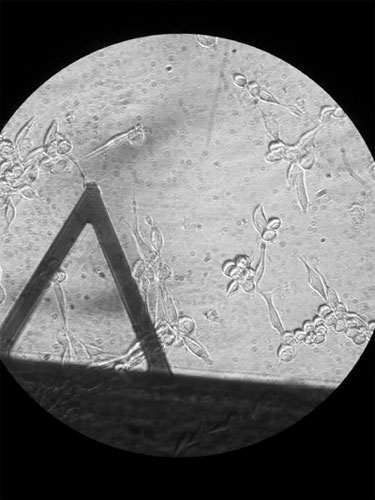
The dark side of the cell is an audio-visual event treating one of the most interesting recent discoveries in nano-biotechnology: cellular sounds. For a long time musicians have been inspired by microscopic life-forms and the fascinating structures of the smallest building blocks of the universe, but not until now have we been able to listen to the sound of living cells. Much mystery is brought forth by the discovery of cellular sound, and few answers can be given.
This project is the collaborative effort of the media artist Anne Niemetz, and the nano-scientist Andrew Pelling, who teamed up to combine their research and interests in nano-biotechnology, sound and installation design.
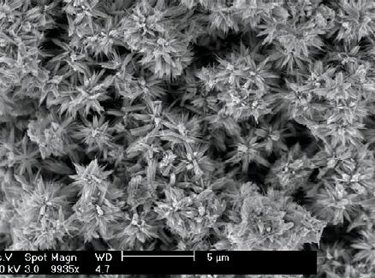
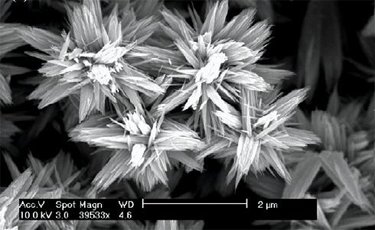
Spectacular flower-like nanostructures grown in a laboratory in China can detect alcohol and might also be useful as catalysts.
The "nanoflowers" were made from zinc oxide by Yujin Chen and colleagues at Harbin Engineering University. Conventional ethanol sensors are made from the same material and work by detecting the change in electrical resistance when a wad of zinc oxide powder or a layer of the material is exposed to ethanol vapour.
But these conventional sensors look set to be replaced by a new generation of detectors. "The sensor materials will probably be replaced with tailored nanostructures since they appear to give a higher sensitivity," explains Edman Tsang, who researches new nanomaterials at the University of Reading in the UK.
Zinc oxide sensors need to be heated to temperatures of up to300°C before they become sensitive to ethanol. Chen's nanoflowers become sensitive at just 140°C.
These crystalline ‘nanoflowers’ were developed by Cambridge University PhD student Ghim Wei Ho. The nanostructures of silicon carbide are grown from droplets of gallium on a silicon surface. These nanoflowers will be used in new applications, such as water repellant coatings or new types of solar cells.
Food for design wants to be an open source for design, food and science cross-over. We are not interested in creating hypes, but in long term co-operations, where everyone benefits. Promoting quality and collective creativity are the things that count... So please take a seat and have a bite! Best view [res: 1024 x 768] x [browser: firefox]
_ random newsletter
_news
_m[eat]ing 003
17.03.2007::MATERIALS ::
Food for design was invited by the Meat & Fresh expo and will install a creative food laboratory at the rambla during the fair,
where people can find inspiration towards form and taste.
[+ more]
_m[eat]ing 002
18.11.2006::MATERIALS ::
A feast of surfaces, textures, colors and other sensorial elements, using a large palette of food materials.
The objective is to inspire new uses for food materials and provoke new applications within a design context.
[+ more]
_seminar
20.09.2006::MG SEMINAR IN BELGIUM ::
This seminar [ 20 november 2006 ] is organised by the innovation and knowledge centre of food for every one who is interested in food science, technology and cooking processes. This can be chefs, scientists, recipe developers, foodies,...
The guest speakers tell and demonstrate how food science and technology can inspire gastronomy...
[+ english][+ dutch]
_manifesto 001
03.02.2006::FOOD for design::
The first aim of this project is to explore and understand the physicochemical properties of materials / ingredients and apply this under-standing when designing.
_manifesto 002
28.01.2006::food for DESIGN::
A different way of thinking : abandoning the role of "creator" and "descending" to the role of a participant playing within the rules of an experimental process.
All experiments come into being as a result of self-formation processes.
_manifesto 001
22.01.2006::food FOR design::
In exploring the materials the main focus lays on the food as in exploring the structure the primary focus lays on the process.
The goal of this cross-fertilisation project is to add more senses / experience to design, it is a way of sustainable, random, natural thinking to in-spire others, giving food for the future.