For nearly four years, an obscure culinary discussion forum called eGullet has had an anonymous guru of sous-vide. The technique — which involves using vacuum-sealed plastic bags to cook foods in water at precisely controlled temperatures — is both relatively new to the home chef and poorly documented. But thanks to user "nathanm," eGullet offers a wealth of insider knowledge, everything from comprehensive tables of cooking times to tips on food safety.
So who is this mysterious Jedi Master? Turns out, nathanm is über-technologist Nathan Myhrvold, former CTO of Microsoft and noted billionaire. Myhrvold first encountered sous-vide at a culinary school in France, but he found the lack of practical information frustrating. "I wanted to figure out how long to cook things," says Myhrvold, now CEO of the "invention" firm Intellectual Ventures. "I did some experiments and then wrote a program using Mathematica to model how heat is transferred through food."
The passion for cooking and food are the central theme of Pixar's recent film - Ratatouille. This complex and multi-faceted problem posed many challenges that were solved using diverse computer graphics and production techniques. In this course we will comprehensively cover all aspects including modeling, dressing, shading, lighting and effects.
The story called for working cooking stations and sloppy mess of a busy, functional kitchen. We will review some of the set concepts, visual framework and even dynamics simulation techniques that were used to create this illusion. We will illustrate with several examples including final plated dishes, mis-en-place setups and the Food Locker.
The challenge of shading food on Ratatouille was to work within the stylized look of the film and yet keep it recognizable and appealing to eat. We developed subtle illumination techniques that added up to a general approach we could use on a variety of objects. We will breakdown examples ranging from vegetables to plated dishes.
Lighting played a key role in making the food look appetizing, a task further complicated by different types of food such as bread, cheese, soup and wine that pushed the boundaries of standard surface based lighting. We will discuss our general approach to lighting food as well as specific challenges and solutions posed by the various dishes.
By screwing on plastic tops, these readily available jars are turned into vessels with a specific function. A generic jar is transformed into kitchenware, creating more practical and emotional value. The family includes a sugar pot, milk jug, chocolate sprinkler, oil&vinegar set and a water jug.
Employing a spectrographic range of colour, self-similar shapes and contours in her pieces, Jen Stark’s works might at first appear as if they were computer rendered. Instead she cuts through sheets of layered paper, revealing the colours below and shaping the cut paper into complex sculptures with mathematical precision.
Mleak : "These are my testers for a project I'm working on using processed lunch meats etched with a laser cutter. Ultimately, I would like to show the entire process from animal to ambiguous pink slice of meat over the course of a package of lunch meat, beginning here with bologna. This neat packaged disc of food has always seemed so far removed from its source."
A sensor that detects odors better than the human nose may be able to smell dangerous air pollutants, soil contaminants, insecticides, food pathogens, biological warfare neurotoxins, and body odors associated with illness and disease. At the University of Illinois at Urbana-Champaign, chemistry professor Kenneth S. Suslick and graduate student Neal A. Rakow have spent four years developing a sensor that sniffs out odors by "seeing" them. Called "smell-seeing" by its inventors, the method relies on color changes that occur in an array of vapor-sensitive dyes in response to exposure. This newest version of an artificial nose is simple, fast, and inexpensive. The ink on this paper changes color when exposed to odor. In the future it could be used on a milk container to detect spoilage.
Croatian creative agency Bruketa & Zinić have designed an annual report for food company Podravka that has to be baked in an oven before it can be read. The report features blank pages printed with thermo-reactive ink that, after being wrapped in foil and being baked at 100°C for 25 minutes, reveal text and images.
All it takes is some german engineering + beercans. Random Screen is a mechanical thermodynamic screen that the user can’t control and that functions without any electricity. Conventional tea candles illuminate and generate the changes on the 4x4 pixel screen.Each individual pixel of Random Screen is an independent unit. Core components are a projection foil, a modified beer can and a small tea candle.The candle serves as a source of light; at the same time, the warmth it gives off sets the modified beer can in motion. The can, modified into a sort of freely rotating fan mounted above the candle, can spin around freely. The candlelight shines through a window cut in the beer can onto a projection surface and makes the pixel light up. Depending on how fast the fan spins, it gently turns the respective pixel either on or off. The larger the candle’s flame, the brighter the pixel shines and the faster its switching frequency. The candlelight is diffused on a second projection foil in the middle of the pixel box in order to generate as little shadow-flickering as possible on the projection surface. The individual pixel boxes stacked on top of and next to one another form the Random Screen. The modularity of the pixels allows the screen surface to be expanded at will, and this construct’s simple components make it easy for others to copy.
Designing bread, workshop avec Alexis Georgacopoulos exhibited in ECAL. Won the price of best school presentation.A baker of St-Etienne produced a serie of 200 of our parisian bread.
Participants: Isabelle Schwager, Abdelaziz Bousetta, Cédric Decroux, Yves Fidalgo, Cédric Fontana, Axel Jaccard, Philippe Michelot, Mohammed Nadini.
How could someone wrap up Takeshi Ishiguro’s work in one sentence? The former product designer for IDEO now works on his own back in Japan, dedicating his full time to experimental technology, conceptual products and beautiful installations. Our favourite star goes to the leaf bowl.
Plants have genes, Animals have genes. Have you ever wondered if products have them? If products have genes, then the methods of design in nature may be applied to products. Genometri is a Singapore based design technology company that just does that. It has developed a generative design technology that allows designers to create 1000's of design variations based on their original design. It is able to explore a huge range of possibilities that is not possible other wise. Texture and color may also be explored. This technology gives designer unprecedented power of exploration creating variations that are significantly distinctive.
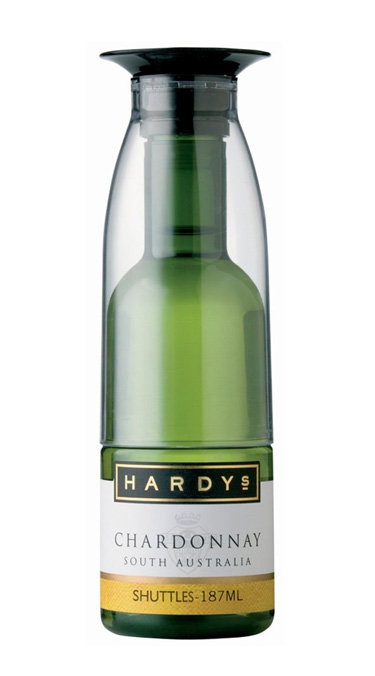
Hardy Wines has launched the Shuttle, which "features a 187ml (single serve) acrylic wine bottle securely sealed by its own acrylic wine glass. The tamper-proof bottle is opened by a simple twist-top action, which also releases the glass in which the wine is poured." Plus, you get to keep the glass afterwards. Finally, an end to guzzling wine directly from the bottle!
These Andrew Andrew cookies featured recently on the "From A to B and Back Again" exhibition. Curated by Tobias Wong & Carlos Salgado; showing work by designers from Brooklyn. [Ph : Joost Van Brug ]
Consider an Orangina bottle: shaped like an orange it is designed to look like one. But it does so in a very primitive way. Imagine the product is the packaging. Wouldn’t it be great if we could grow Orangina bottles?
It is not hard to imagine that genetic technology makes it possible to grow oranges with a hard plastic skin. In additon, oranges can be modified to produce enzymes which degrade the flesh of the orange resulting in a self-generated juice… better than the real thing!
Goodbye, pesky stickers. A growing number of produce packers and distributors are experimenting with natural-light labeling, a new process that uses a laser to etch identifying information (country of origin, variety, etc.) into the skins of fruits and vegetables without bruising or causing other damage. In our taste tests with pears from Southern Oregon Sales, the labeled areas proved entirely edible, if oddly textured. The process allows suppliers to attach more specific data to individual items—such as when a peach will be ripe enough to eat and other handy tidbits—in a way that won't stick to your hair.
Food for design wants to be an open source for design, food and science cross-over. We are not interested in creating hypes, but in long term co-operations, where everyone benefits. Promoting quality and collective creativity are the things that count... So please take a seat and have a bite! Best view [res: 1024 x 768] x [browser: firefox]
_ random newsletter
_news
_m[eat]ing 003
17.03.2007::MATERIALS ::
Food for design was invited by the Meat & Fresh expo and will install a creative food laboratory at the rambla during the fair,
where people can find inspiration towards form and taste.
[+ more]
_m[eat]ing 002
18.11.2006::MATERIALS ::
A feast of surfaces, textures, colors and other sensorial elements, using a large palette of food materials.
The objective is to inspire new uses for food materials and provoke new applications within a design context.
[+ more]
_seminar
20.09.2006::MG SEMINAR IN BELGIUM ::
This seminar [ 20 november 2006 ] is organised by the innovation and knowledge centre of food for every one who is interested in food science, technology and cooking processes. This can be chefs, scientists, recipe developers, foodies,...
The guest speakers tell and demonstrate how food science and technology can inspire gastronomy...
[+ english][+ dutch]
_manifesto 001
03.02.2006::FOOD for design::
The first aim of this project is to explore and understand the physicochemical properties of materials / ingredients and apply this under-standing when designing.
_manifesto 002
28.01.2006::food for DESIGN::
A different way of thinking : abandoning the role of "creator" and "descending" to the role of a participant playing within the rules of an experimental process.
All experiments come into being as a result of self-formation processes.
_manifesto 001
22.01.2006::food FOR design::
In exploring the materials the main focus lays on the food as in exploring the structure the primary focus lays on the process.
The goal of this cross-fertilisation project is to add more senses / experience to design, it is a way of sustainable, random, natural thinking to in-spire others, giving food for the future.