This project investigates the self-organization of two materials, plaster and elastic fabric, to produce evocative visual and acoustic effects. Inspired by the work of the Spanish architect Miguel Fisac and his experiments with flexible concrete formwork in the 1960-70s, p_wall attempts to continue this line of research and add to it the ability to generate larger and more differentiated patterns. Starting from an image, a cloud of points is generated based on the image’s grayscale values. These points are then used to mark the positions of dowels which constrain the elasticity in the fabric formwork. Plaster is then poured into the mould and the fabric expands under the weight of the plaster. The resultant plaster tile has a certain resonance with the body as it sags, expands, and stretches in its own relationship with gravity and structure. Assembled into a larger surface, a pattern emerges between the initial image’s grayscale tones and the shadows produced by the wall.
These cake was designed by Jamie Fobert, an architect, for the London bakeries Konditor & Cook. He was inspired by the work of the sculpture Barbara Hepworth. 4 more British design talents did some other designs, they will all become available in course of the year at the London stores.
Oxman's "Cartesian Wax" is a material designed to replicate the multiple functionalities of living tissue. It uses a combination of flexible and rigid resin to create a building "skin" that evokes living matter and responds to its local environment; its transparency level is modulated based on local heat and light conditions. The work was inspired by Descartes's Wax Argument: Descartes argued that because we can identify wax as wax, even when its physical properties change in the presence of heat, we know our mind has an important role exceeding that of our limited senses.
In 1997 a number of architects were invited to participate in the production of macaroni. The exhibition showcased their macaroni models--fifty times larger than ordinary macaroni--along with their production intent and original recipe for cooking macaroni, as well as the participants' profiles and master works. As macaroni is made of ground grain, it can basically take any shape. However, macaroni is an architecture that guarantees conditions much harder to fulfill than is first imagined. Working conditions include "a shape that can be evenly heated", "an ample area that can be coated with sauce", "a shape easily mass-produced" and "appealing to the sense of taste". The operation exerted in this project can be expressed as "architecture for food". The participating architects thus competed with each other in the architectural design of food. As a result, the philosophy of each one is revealed practically as "macaroni". Thus, the creative ideas of architects, which often seem too heavy for the general public to understand, have now manifested themselves as plain, practical media. Production by Kenya Hara.
The most earthly looking eco-burial container that we’ve found is the Capsula Mundi, created by a pair of Italian designers who wanted to remove the taboo from the burial process and give it a new conception.
The Capsula Mundi is an egg-shaped container made of bioplastic. The body of the deceased rests in a fetal position within this capsule, which gets planted in the earth like a bulb. A shallow circular depression is dug above the capsule to symbolize the presence of the body, in the center of which a tree is planted. Over time, the groups of burial sites become a sacred memorial grove.
The Capsula Mundi has made appearances as a design piece in exhibitions around Europe, including one with Droog Design last year. As a show piece, the design is a quintessential representation of a sprouting seed, perfectly encapsulating the designers’ goal of regarding death as an opportunity to nourish the earth for the future.
Just when you thought mushrooms were only useful as culinary garnishes, Gavin McIntyre and Eben Bayer, two students from the Rensselaer Polytechnic Institute have found a more noble purpose for the functional fungi- building insulation made from oyster mushrooms.
Greensulate is a fire-retardant board made out of water, flour, perlite, and mushroom spores. The idea came from an assignment which asked that they produce a form of sustainable insulation. The insulation material is grown by pouring the ingredients into 7 by 7 inch molds with hydrogen peroxide. When this mixture is placed in a dark environment, the mushroom oyster cells start to grow into a 1 inch thick panel, which is then dried to prevent fungus from growing. The pair have a working prototype, which in true college fashion, was grown under their beds.
“I think it has a lot of potential, and it could make a big difference in people’s lives,” said RPI Professor Burt Swersy, whose Inventor’s Studio course inspired the product’s creation. “It’s sustainable, and enviro-friendly, it’s not based on petrochemicals and doesn’t require much energy or cost to make it.”
By the year 2050, nearly 80% of the earth's population will reside in urban centers. Applying the most conservative estimates to current demographic trends, the human population will increase by about 3 billion people during the interim. An estimated 109 hectares of new land (about 20% more land than is represented by the country of Brazil) will be needed to grow enough food to feed them, if traditional farming practices continue as they are practiced today. At present, throughout the world, over 80% of the land that is suitable for raising crops is in use (sources: FAO and NASA). Historically, some 15% of that has been laid waste by poor management practices. What can be done to avoid this impending disaster?
The concept of indoor farming is not new, since hothouse production of tomatoes, a wide variety of herbs, and other produce has been in vogue for some time. What is new is the urgent need to scale up this technology to accommodate another 3 billion people. An entirely new approach to indoor farming must be invented, employing cutting edge technologies. The Vertical Farm must be efficient (cheap to construct and safe to operate). Vertical farms, many stories high, will be situated in the heart of the world's urban centers. If successfully implemented, they offer the promise of urban renewal, sustainable production of a safe and varied food supply (year-round crop production), and the eventual repair of ecosystems that have been sacrificed for horizontal farming.
The Naica Mine of Chihuahua, Mexico, is a working mine that is known for its extraordinary crystals. Naica is a lead, zinc and silver mine in which large voids have been found, containing crystals of selenite (gypsum) as large as 4 feet in diameter and 50 feet long. The chamber holding these crystals is known as the Crystal Cave of Giants, and is approximately 1000 feet down in the limestone host rock of the mine. The crystals were formed by hydrothermal fluids emanating from the magma chambers below. The cavern was discovered while the miners were drilling through the Naica fault, which they were worried would flood the mine. The Cave of Swords is another chamber in the Naica Mine, containing similar large crystals.
OMA developed foam as part of their work for Prada. Foam is a poly urethane cast of an aggregrate condition between solid and void. It is both a regular and irregular structure of spongelike consistency that can be cast in stages from hard to soft, and from transparent to opaque. It forms a substance that can be used to build objects as well as entire spaces a further interpretation of solid and void. Foam was developed beginning with an architectural model using a regular cleaning sponge. Because the visual effect of this backlit texture was very intriguing, OMA initiated an extensive search to recreate this material in 1:1 scale. Vincent De Rijk made hundreds of prototypes in order to test the hole sizes, percentages of openness, translucencies, depths, colors, etc. In its multiple and varied manifestations, Foam offers a new definition of functional and visual properties between artificial and natural, irregular and regular, transpararent and opaque, translucent and solid, flexible and rigid qualities in the design of interior environments.
"Polytop" is a RANGE of a mass customized coffee tables: each table is different but similar without changing the cost of production: the generative automaton processs for each single entity is starting from the same base frame (according to material and standart sheet size); the code is first plotting a number of pts (according to user specifications) to create a pt cloud onto which is running a customized 2.5D Voronoi; here speculating further onto the use of Vornoi diagrams within the field of design, theverymany is looking at optimization within the production process (more of problem caring than problem solving): only 3 axis require for the CNC cut (though the use of a taper tool allows smoother transitions), reducion of the amout of cuts (each cut is used on both side of the line) and reduction of waste of material : within the production process, every cut out is used to produced an n+2 layer within the vertical section: with one sheet of material you can therefore produce at least 3 to 5 layers.
FogQuest is an innovative, international, non-governmental, non-profit organization, which implements and promotes the environmentally appropriate, socially beneficial and economically viable use of fog, rain and dew as sustainable water resources for people in arid regions of developing countries. FogQuest plans and implements water projects for rural communities in developing countries. They utilize innovative fog collectors as well as effective rainfall collectors to make optimum use of natural atmospheric sources of water.
David Benjamin and Soo-in Yang of ‘The Living’ Architects presented their recent work at the Interactive Architecture event which Ruairi Glynn organised at Eyebeam last month. They have just released 2 lovely little books called ‘Life Size‘ 1 & 2 which explore the possibility of creating open source design processes. The first volume of Life Size includes ‘DIY directions for making a responsive kinetic system, an energy self-sufficient display, and a collapsible framing structure out of weak materials.’ & the second volume of this series includes essays by Yoseph Bar-Cohen, Livia Corona, Holly Kretschmar, Seth Mnookin, William Wu and SISYPHUS.
Whats most interesting for me about David and Soo-ins work is their methodology they call "flash research," which they define as an architectural research project with a budget under $1000 and a ninety-day timeline, expected to result in a fully functioning, 1:1 scale prototype. To me this seems a challenging approach that forces you to consider low tech solutions rather than spending a fortune on answering problems often with unsustainable answers.
David and Soo-in run a graduate class at Columbia Architecture school where with their students, they continue to experiment with these ideas of rapid experimentation often in the context of responsive & kinetic spatial design. Check out their website where you can find out more about their projects such as living River Glow, a network of pods that act as an interface between the water quality of the river and local inhabitants awareness of environmental conditions and Living Glass, a silent transforming and transparent surface that responds to inhabitants proximity.
Another cool project from Domus, this time a "vertical cemetary" whose "commitment to quality is eternal." Though it looks like something out of Perdido Street Station, it's really a skyscraping extension to the Memorial Necrópole Ecumênica, "a vertical cemetery established in Santos in Brazil in 1983." This futuristic, insectile extension "will create another 25,000 niches, set inside a 108-metre-high tower block that will complete the complex."It will be circled by birds, looming alien on the horizon. The vertical cemetery is particularly widespread in Brazil and is also beginning to be used in other places: the Panteón Memorial Towers complex, which consists of 13 towers in a vaguely deconstructivist style, has recently been presented at Bogotá in Colombia and sparked debate concerning changes in funeral rituals related to the social changes that have taken place over the last 30 years. In the South Korean pavilion at the last Venice Architecture Biennale, the project The Last House by architect Chanjoong Kim (founder of System Lab) addressed the same notion, bringing it into line with more contemporary architectural styles and approaches and drawing on a zoomorphic language that echoed systems of vascular circulation. Architecture appears swift to take the opportunity to address a new area where death creates a market, on the borderline between consumerism and entertainment.
The Exploratorium, wins the AIA award for the design of the "Wave Wall," a kinetic skin on the surface of the new Science Education Center at the Laser Interferometer Gravitational-Wave Observatory (LIGO) in Livingston, Louisiana. The jury of principals from leading architectural firms said of the LIGO Science Education Center, “Form and function come together in an exciting and unexpected way in the design of this building where a dynamic exterior wall suggests its purpose: a science education center.”Wave Wall, a kinetic wind sculpture involving 120 27-foot-long pendulums installed across the entire 85-foot length of the center’s façade, was exclusively designed for the site by Exploratorium artists.
Landscapes change when the weather changes, the light becomes different and the whole atmosphere changes. Rain makes everything beautiful, I can smell the surroundings. All materials seem to alter.
Solid Poetry is a concrete tile that reacts on water. It's a symbiosis between concrete and water. As the water flows onto the concrete tile, images or patterns will appear. We try to explore the possibilities for hidden design appearing as the environment changes. We applied techniques to an enduring and solid material, so that natural processes reveal patterns. Rain uncovers decoration on a city square. The possible applications of solid poetry are various: either at home in the bathroom, in the garden or public spaces like bus stops or pavements. All forms of solid poetry have in common that they change the whole setting; they are surprising and have a life of their own. With time the tiles change, usage leaves it traces and the patterns will be permanently visible. Design by:Susanne Happle & Frederik Molenschot
In 2002, Ned Kahn worked with the staff of Technorama, the major science center in Switzerland, and their architects, Durig and Rami, to create a facade for the building which is composed of thousands of aluminum panels that move in the air currents and reveal the complex patterns of turbulence in the wind.
:: Fragmented Dunes ::
A wind-animated shade screen for the new performing arts center that consists of thousands of 9-inch squares of perforated aluminum mounted on low friction hinges so that the entire surface of the facade responds to the wind. Each moving panel is perforated with thousands of different sized holes that, when viewed from a distance, create a photographic mosaic of sand dune images. When sunlight passes through the screens, intricate shadow images of the dunes are projected onto the walls and floor of the lobby. The design evolved from a collaboration with BOORA and DWL Architects and the engineering firm Paragon.
People wrote about Behrokh Khoshnevis’ awe-inspiring, rapid-prototyping “robo builder” in 2005 when it was still a work in progress. But now, the University of Southern California professor’s contour crafting machine will be put to the test; it’s scheduled to erect its first house in California within the next few months. The two-story house will built in less than 24 hours out of only concrete and gypsum — and without the help of a single human hand. Khoshenevis’ groundbreaking robo-builder has caused some raised eyebrows and dropped jaws within the architectural community, as the machine provides a new model for construction that drastically cuts building timelines, material, manpower, and most importantly, waste and carbon emissions.
Marc Fornes is currently working in London for Zaha Hadid Ltd as a project architect for the MIDR "Mediatheque de Pau" (developed in collaboration with Alvin Huang and Vincent Nowak. He graduated of the AA DRL (jan04) and is currently teaching assistant at the Royal College of Arts (London) regarding Rhino. We love his work and approach.Take your time to check his blog and his code recepies.
The example above: In mathematics, a Voronoi diagram, named after Georgy Voronoi, also called a Voronoi tessellation, a Voronoi decomposition, or a Dirichlet tessellation (after Lejeune Dirichlet), is special kind of decomposition of a metric space determined by distances to a specified discrete set of objects in the space, e.g., by a discrete set of points.
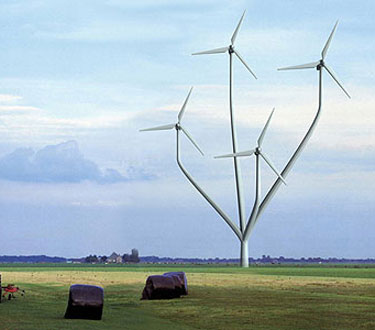
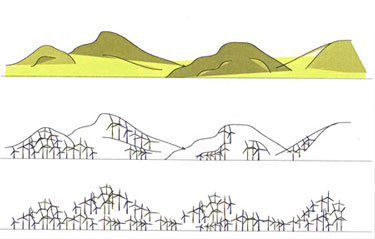
On the subject of art imitating trees, check out this awesome design for tree-like windmills, from One Architecture, Ton Matton and NL Architects in the Netherlands. Leave it to the Dutch to come up with such a clever, beautiful, eco-friendly idea for power generation. This design was comissioned by the Dutch government, to develop a next-generation windmill that would be less intrusive in the flat Dutch landscape than the industrial mill-parks that currently generate much of the Netherlands power. The proposed windmill uses an organic branching design that can hold up to 8 turbines and grow as tall as 120 meters.
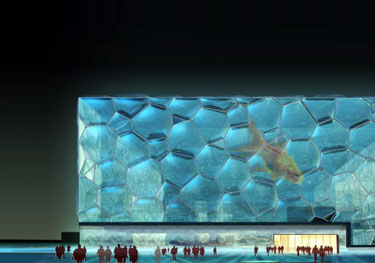
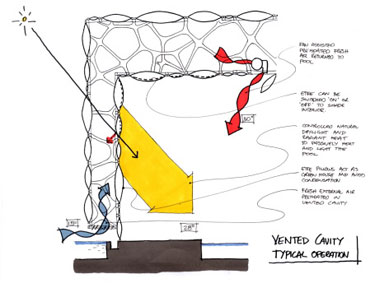
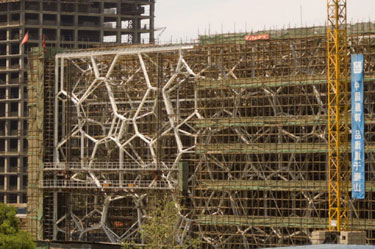
The official swimming facility of the 2008 Olympics in Beijing, China, will span 7.8 acres, house five pools, and seat 17,000 spectators, yet it doesn’t contain a single steel cable, concrete column or structural beam. Instead its walls and ceilings are composed of a network of slender steel pipes linked together by 12,000 load-bearing nodes. These nodes evenly distribute the weight of the building, making it strong enough to withstand Beijing’s most severe earthquakes. A plastic Teflon-like foil—just eight one-thousandths of an inch thick—covers the entire structure like skin. It lets in more light and heat than glass does, helping to keep the pools warm and slashing energy costs by 30 percent. Construction wraps up this year with the official opening scheduled for the Summer Olympics.
Food for design wants to be an open source for design, food and science cross-over. We are not interested in creating hypes, but in long term co-operations, where everyone benefits. Promoting quality and collective creativity are the things that count... So please take a seat and have a bite! Best view [res: 1024 x 768] x [browser: firefox]
_ random newsletter
_news
_m[eat]ing 003
17.03.2007::MATERIALS ::
Food for design was invited by the Meat & Fresh expo and will install a creative food laboratory at the rambla during the fair,
where people can find inspiration towards form and taste.
[+ more]
_m[eat]ing 002
18.11.2006::MATERIALS ::
A feast of surfaces, textures, colors and other sensorial elements, using a large palette of food materials.
The objective is to inspire new uses for food materials and provoke new applications within a design context.
[+ more]
_seminar
20.09.2006::MG SEMINAR IN BELGIUM ::
This seminar [ 20 november 2006 ] is organised by the innovation and knowledge centre of food for every one who is interested in food science, technology and cooking processes. This can be chefs, scientists, recipe developers, foodies,...
The guest speakers tell and demonstrate how food science and technology can inspire gastronomy...
[+ english][+ dutch]
_manifesto 001
03.02.2006::FOOD for design::
The first aim of this project is to explore and understand the physicochemical properties of materials / ingredients and apply this under-standing when designing.
_manifesto 002
28.01.2006::food for DESIGN::
A different way of thinking : abandoning the role of "creator" and "descending" to the role of a participant playing within the rules of an experimental process.
All experiments come into being as a result of self-formation processes.
_manifesto 001
22.01.2006::food FOR design::
In exploring the materials the main focus lays on the food as in exploring the structure the primary focus lays on the process.
The goal of this cross-fertilisation project is to add more senses / experience to design, it is a way of sustainable, random, natural thinking to in-spire others, giving food for the future.