The "Living Systems" installation is the result of a series of experiments with organic plastics developed by Seymour and is now for display at the vitra design museum. Seymour began the experiments some time ago in his home town of Berlin, and the latest products of his researches are now on display.
The plastic is produced by extracting the starch from potato, mixing it with milk and heating it to make it liquid. The material, which is biodegradable, hardens on a bed of sand and forms the material base for a range of furnishings. When dyed with food colouring the material can be turned into children's chairs or daybeds, which look as if they have been cast in brightly coloured icing.
However, what at first looks like a playful experiment is based on a very serious idea. How is it possible today for people to live an autonomous life and take care of their own needs? Seymour, who grew up in Canada, looks for answers at a design level. After many years of experience as a designer of objects in plastic, which were partly produced with complex moulds, Seymour, who clearly attaches a great deal of importance to freedom, asked himself the question of how designers can free themselves from the restrictions imposed by production. With his do-it-yourself experiments he has released himself from production processes which are becoming ever more complex and opaque, reflecting afterwards on the design autonomy which this provides.
Food for Design as we may speak. We did some more research and bumped into the following recipe/process.
Recipe : -1900 g Potato or potato skins -6000 g water -580 g milk -1400 g (potato) starch -140 g whey protein
The potato skins are dry chopped to 1 mm pieces in an industrial blender. The heated water/milk blend (heated to 65 DEG C) is then added to the potato skins and blended in the industrial blender. The potato starch is mixed in to the water/milk/skins solution. Finally, the whey protein concentrate is added to the mix and thoroughly blended in the blender.
Moto Restaurant's 21-year-old Pastry Chef Ben Roche demonstrates the unique dining experience at Moto with his version of Carrot Cake, Nachos and Wine and Food Pairing.
Twenty-two year old, Ben Roche discovered a fascination with science after creating Alka Seltzer “bombs” as a young boy in his best friend’s kitchen in Beaufort, South Carolina. So it seems fitting that this young, aspiring pastry chef now finds himself working alongside Postmodern culinary star, Chef Homaro Cantu. At Moto where the kitchen resembles a lab with tanks of nitrogen gas, helium and liquid nitrogen being used daily in cooking techniques, Roche’s love of science and his Johnson & Wales culinary degree are in perfect harmony.
This is a translation of the recipes in an article by Jean Pierre Gabriel for Le vif express where Sang Hoon Degeimbre (the chef of L’air du temps) and Bernard Lahousse (food for design) had a discussion on food pairing. The combination of oyster and kiwi is a food pairing by Sang Hoon. The 2 others where inspired by Heston Blumenthal (mango/pine and pineapple/blue cheese). For more info on foodpairing look to our earlier posts on this topic.
Included some recipes by Sang Hoon Degeimbre
A. FOOD PAIRING OF MANGO AND PINE
description : Ravioli filled with mango mousse, beads of yoghurt and pine (for 4 persons)
- 1 ripe mango
- 200 g mango puree
- 3,5 g gelatine
- 2 shoots of a young pine (the very tender, fresh leaves)
- 3,5 g of methylcellulose
- Lemon juice
- Rose leaves
For the yoghurt beads:
- 200 g yoghurt
- 90 g double cream
- 30 g sugar
- 2 drops of pine extract
For the alginate bath:
- 1 liter water
- 5 g alginate
Recipe:
Cut the mango into fine (maximum 1mm) sheets.
Mix the mango puree with the shoots of the pine (cut into fine pieces).
Divide the mango puree into two parts. The first part is heated to 40°C and mixed with the gelatine. The second part is kept cool and mixed with the methylcellulose. Beat the 2 parts together into a light foam.
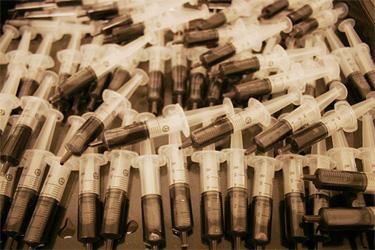
For the yoghurt beads; mix all the ingredients. Make an alginate bath (reverse spherification) by mixing the water with the alginate. Fill syringes with the yoghurt mixtures. Inject the mixture into the alginate bath so you get beads (2 cm diameter). Leave the beads into the bath for 2 minutes. Rinse in water and leave into the water until use.
Fold the mango sheets into 4 to form like little cornets. Fill the cornets with the mango foam.
Dress the cornets on a plate together with the yoghurt beads, some mango coulis, leaves of roses and shoots of pine
B.FOOD PAIRING OYSTER AND KIWI
description : Kiwître (for 4 persons)
- 4 oysters
- 2 kiwis
- 100 g coconut puree
- 1 spoon lemon juice
- 50 g fresh sepia ink
- 1 tea spoon wasabi powder
- 1 g tara gum
- 0,5 g methylcellulose
Recipe:
Mix the coconut with the tara gum. Sieve. Keep fresh during 1 hour.
Mix the sepia ink with the methylcellulose. Keep in the fridge
Peel the kiwi. Cut into small pieces (5mm) but discard the white parts. Mix the wasabi together with the kiwi pieces.
Open the oysters.
On a plate put a spoon of kiwi pieces. On top the kiwi. Put a drop of sepia ink and a spoon of coconut next to the oyster.
C. FOOD PAIRING; PINEAPPLE AND BLUE CHEESE Description : Fourme d’Ambert on a jelly of pineapple, fennel, apple and sirop de Liège (for 4 persons)
- 200 g pineapple
- 40 g Fourme d’Ambert
- 20 g granny smith (cut into julienne)
- 20 g fennel (cut into julienne)
- 30 g sirop de Liège
- Powder sugar
- Lemon juice
- 1,5 g agar agar
- Oil of grilled pistachio nuts
- 3 g harissa
Recipe:
Cut 4 fine round pieces out of the pineapple. Place on a silpat, cover with powder sugar, dry into an oven of 110°C during 50 minutes. When ready and still hot roll the pineapple into cylinders.
Make juice out of the rest of the pineapple. Add lemon juice and agar agar. Heat to solve the agar agar, pour in the liquid into a rectangular shape and cool to solidify. Cut into pieces of 5 cm to 1,5 cm.
Cut the cheese in the similar size. Put on top of the pineapple.
Mix the sirop de Liège with the harissa.
Put the apple and fennel julienne on top of the cheese. Decorate with the pineapple cylinder. Add the sauce of sirop de Liège.
Japanese sake (alcoholic content: 14.3%) was heated to an appropriate temperature and filled in a glass vessel for storage while it was kept under reduced pressure. The pressure in the vessel at this time was 0.74 kg/cm². The vessel containing the "sake" was cooled in a home freezer.
The cooling curve obtained at this time is shown above
The sake contained in the vessel is present in the liquid state until the temperature reached point A in the curve. At the temperature corresponding to point A, the "sake" starts to freeze, and the primary freezing is completed at the temperature corresponding to point B in the curve. That is, the temperature at point A is defined as the starting temperature of freezing. At the temperature corresponding to point C near point A in the curve, the vessel containing the "sake" is taken out from the freezer to serve for drinking.
When the "sake" thus supercooled was poured into a glass which had been cooled in readiness, the poured "sake" was frozen in the glass, resulting in a sherbet-like "sake".
A non-Newtonian fluid is a fluid in which the viscosity changes with the applied strain rate. As a result, non-Newtonian fluids may not have a well-defined viscosity.Although the concept of viscosity is commonly used to characterize a material, it can be inadequate to describe the mechanical behavior of a substance, particularly non-Newtonian fluids.
An inexpensive, non-toxic sample of a non-Newtonian fluid sometimes known as oobleck can be made very easily by adding corn starch to a cup of water. Add the starch in small portions and stir it in slowly. When the suspension nears the critical concentration - becoming like single cream in consistency - the so called "shear thickening" property of this non-Newtonian fluid becomes apparent. The application of force - for example by stabbing the surface with a finger, or rapidly inverting the container holding it - leads to the fluid behaving like a solid rather than a liquid. More gentle treatment, such as slowly inserting a spoon, will leave it in its liquid state. Trying to jerk the spoon back out again, however, will trigger the return of the temporary solid state. A person moving quickly and/or applying sufficient force with his feet can literally walk across such a liquid (see video link above).
Shear thickening fluids of this sort are being researched for bullet resistant body armor, useful for their ability to absorb the energy of a high velocity projectile impact but remain soft and flexible while worn.
A familiar example of the opposite, a shear-thinning fluid, is paint: one wants the paint to flow readily off the brush when it is being applied to the surface being painted, but not to drip excessively.
FOOD FOR DESIGN MOLECULAR DESSERTS AT DESIGNERS' LOUNGE
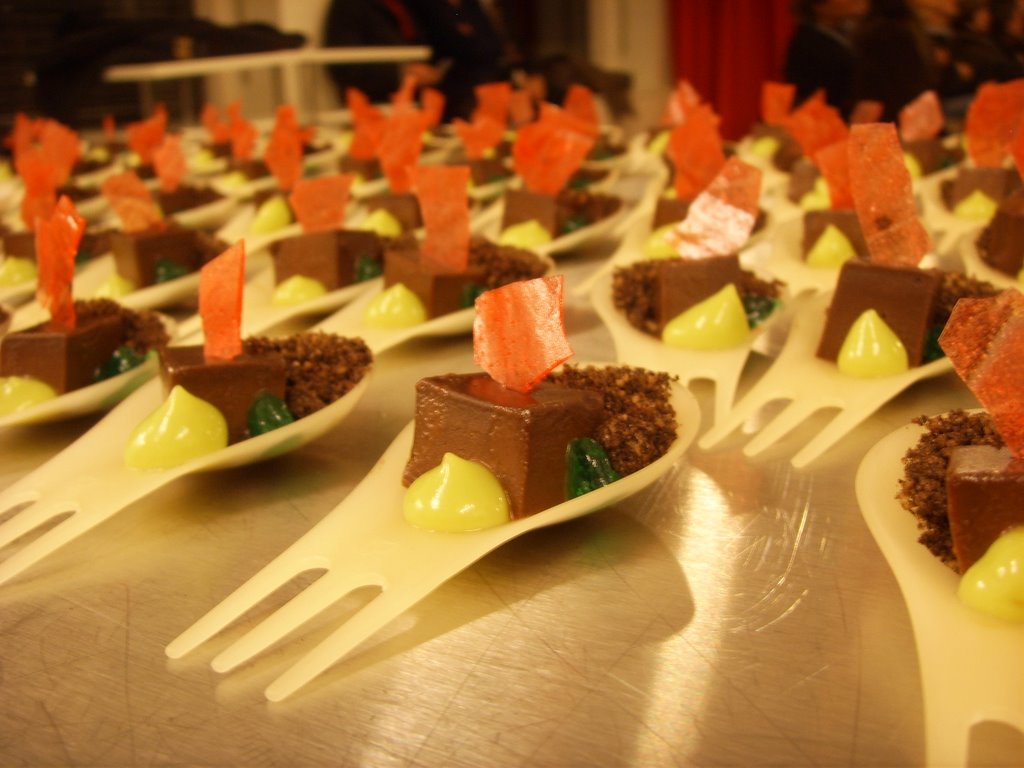
Designers' lounge in Kortrijk with designer of the year Alain Berteau. Food for design provide some molecular gastronomy desserts like a sugar bonbon filled with walnut oil and chocolate soil or soft chocolate, avocado, mint inspired by the pastry chef from WD~50 Alex Stupak.
Not only the food, ambiance are premium at WD-50. Even the cocktails underline the richness of the restaurant. Jose Miranda of WD-50 in New York makes a Malta Fizz, with an egg yolk. The strangest ingredients sometimes make the best drinks. Real bartenders occasionally invent cocktails that their customers would rather not try. The trouble may be personal, an aversion rooted in an unhappy memory. But we tasted it and indeed it was superb.
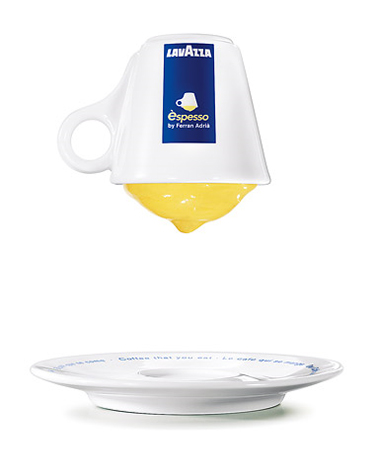
Spanish culinary mastermind Ferran Adrià is famous for tinkering with food at the molecular level to produce wonders like liquid ravioli and frozen Parmesan air. His latest gastronovelty: solid espresso, dubbed èspesso. It's made by combining regular espresso with sugar and a secret ingredient, then squirting it out of a canister like whipped cream. You eat it with a spoon. The mousselike treat arrived in the U.S. in September, and is available in espresso, cappuccino and macchiato flavors.
Wagashi (Japanese: 和菓子) is a general term applied to different types of Japanese snacks, especially sweet ones made of sticky rice, fruits, etc. served in Japanese tea ceremonies. Wagashi is a type of snack made from all natural, plant based ingredients that influences all five senses. They are commonly named from natural beauties and a word from ancient literatures. Typical ingredients include glutinous rice, chestnuts, sweet potato paste and sesame seeds. Sophisticated sweets made from beans and agar-agar are often in the shape of seasonal objects. Inspiration for some new MG recipes?
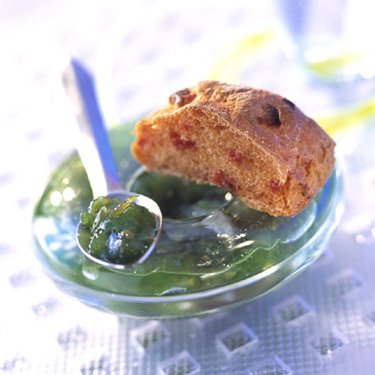
[+ image 01] Space recipe 'Spirulina Gnocchis' [+ image 02] Space recipe 'Martian bread and green tomato jam'
'Martian bread and green tomato jam', 'Spirulina gnocchis' and 'Potato and tomato mille-feuilles' are three delicious recipes that two French companies have created for ESA and future space explorers to Mars and other planets.
The challenge for the chefs was to offer astronauts well-flavoured food, made with only a few ingredients that could be grown on Mars. The result was 11 tasty recipes that could be used on future ESA long-duration space missions. ADF – Alain Ducasse Formation and GEM are the two French companies that produced the recipes, and their mutual experience in creating new products and ‘haute cuisine’ have led to excellent results.
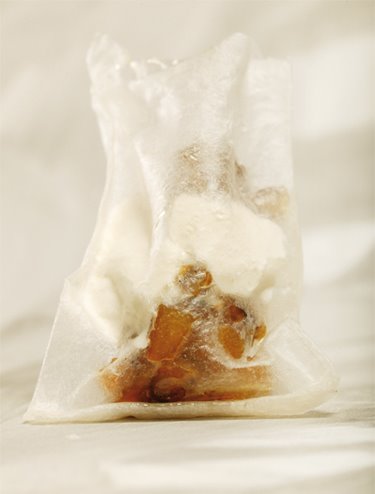
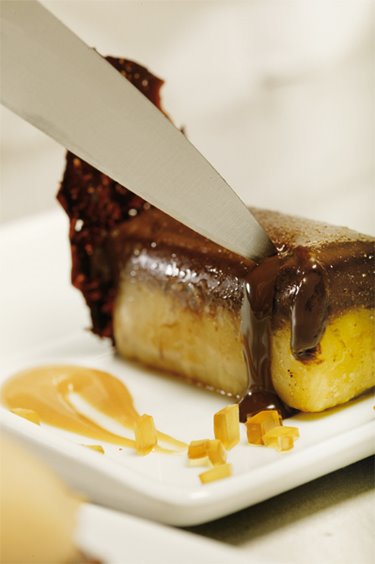
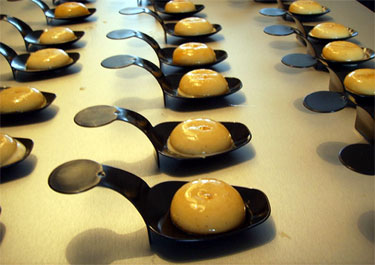
4 different desserts were made last sunday. 2 new recipes: 'Pearl of Crême brulée' and 'Panna cotta with gelle of sweet white wine'. 2 recipes inspired by Sam Mason the pastry chef of WD-50: 'Carrot-Lime ravioli, coconut tapioca, cumin' and 'Raisin puree, ice-cream of brown ice, raisin paper'
Recipes are posted on Flickr. The 2 new desserts are made with ingredients of Sosa (for Belgium contact Cnudde nv); gellan and gelatine vegetale. Especially the gelatine vegetale is very nice, it gives the possibilities like alginates without the use of CaCl2. You only have the freeze the filling. The membrane is solidified by putting the ice in the hot liquid.
[+ more] website of Sam Mason with some recipes and very nice pictures of his desserts
Food for design wants to be an open source for design, food and science cross-over. We are not interested in creating hypes, but in long term co-operations, where everyone benefits. Promoting quality and collective creativity are the things that count... So please take a seat and have a bite! Best view [res: 1024 x 768] x [browser: firefox]
_ random newsletter
_news
_m[eat]ing 003
17.03.2007::MATERIALS ::
Food for design was invited by the Meat & Fresh expo and will install a creative food laboratory at the rambla during the fair,
where people can find inspiration towards form and taste.
[+ more]
_m[eat]ing 002
18.11.2006::MATERIALS ::
A feast of surfaces, textures, colors and other sensorial elements, using a large palette of food materials.
The objective is to inspire new uses for food materials and provoke new applications within a design context.
[+ more]
_seminar
20.09.2006::MG SEMINAR IN BELGIUM ::
This seminar [ 20 november 2006 ] is organised by the innovation and knowledge centre of food for every one who is interested in food science, technology and cooking processes. This can be chefs, scientists, recipe developers, foodies,...
The guest speakers tell and demonstrate how food science and technology can inspire gastronomy...
[+ english][+ dutch]
_manifesto 001
03.02.2006::FOOD for design::
The first aim of this project is to explore and understand the physicochemical properties of materials / ingredients and apply this under-standing when designing.
_manifesto 002
28.01.2006::food for DESIGN::
A different way of thinking : abandoning the role of "creator" and "descending" to the role of a participant playing within the rules of an experimental process.
All experiments come into being as a result of self-formation processes.
_manifesto 001
22.01.2006::food FOR design::
In exploring the materials the main focus lays on the food as in exploring the structure the primary focus lays on the process.
The goal of this cross-fertilisation project is to add more senses / experience to design, it is a way of sustainable, random, natural thinking to in-spire others, giving food for the future.